About Portrush
Portrush, a small seaside resort town on the north coast along the Causeway Coastal Route in Northern Ireland, is one of Northern Ireland’s most popular seaside resorts. The name Portrush from Irish: Port Rois, meaning “promontory port”, however, has also had several variations including Portross and Port Ruis throughout the years.
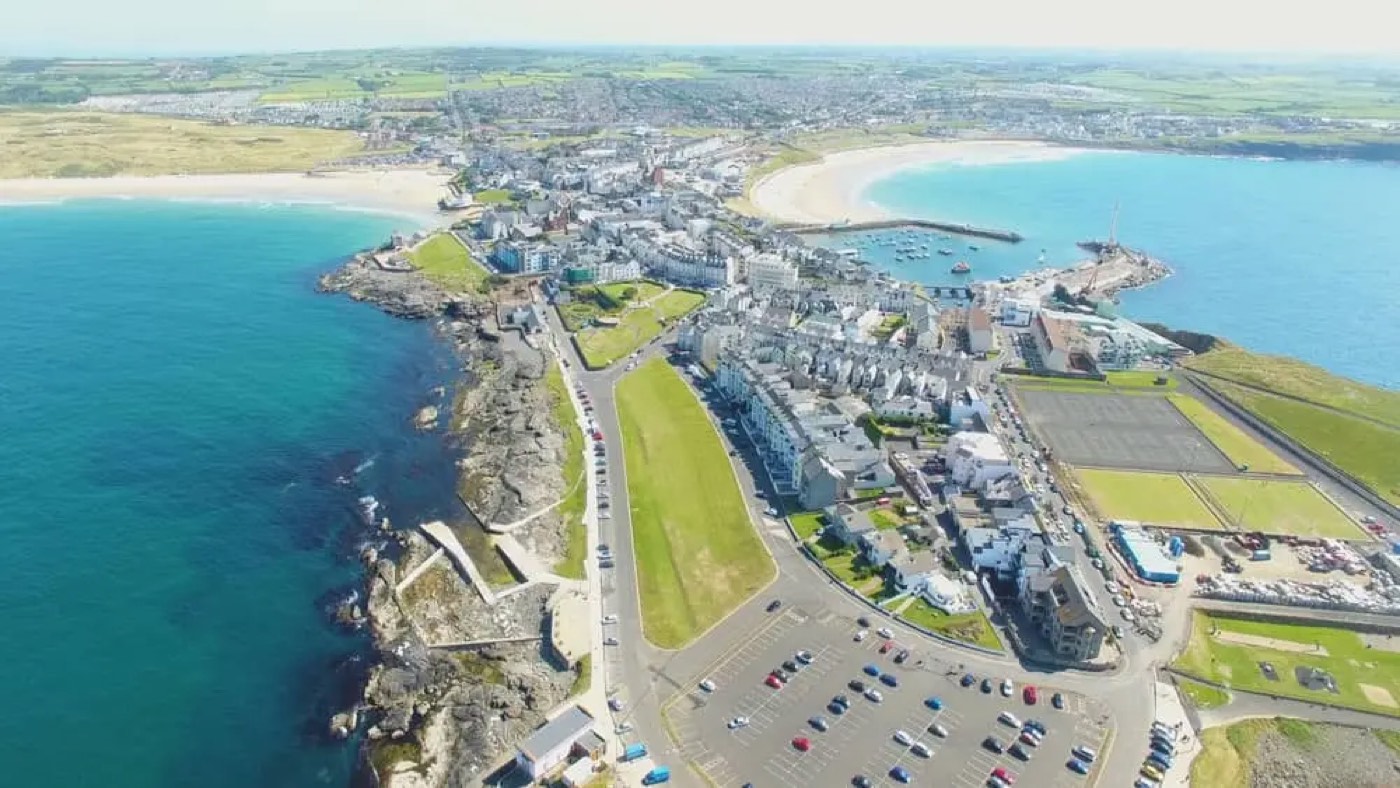
The town is on the Antrim side of the border between County Antrim and County (London)Derry. The central part of Portrush town centre is built on a mile-long peninsula, called Ramore Head, pointing out northwards into the Atlantic Ocean. This is where most of the hotels, restaurants and bars are situated.
Portrush is probably best known for, among many many other things, for its three spectacular Portrush beaches. These are East Strand (Strand meaning Beach), West Strand and White Rocks, which both have been awarded Blue Flag status, that recognises their water quality and facilities. The beaches stretch along the coastline, offering long expanses of sand and scenic views. During the summer months, Portrush becomes especially popular, with increased visitor numbers and bustling activity. Barry’s Amusements, the largest amusement park in Ireland and a historic local landmark since 1925, is also a major and iconic attraction in the town.
Portrush lies in the Causeway Local Council Ward or Causeway Coast and Glens Council. The town also lies in the East Londonderry constituency for the U.K. Parliament and Northern Ireland Assembly.
The geography of Portrush provides stunning views across the Atlantic Ocean, with vistas extending towards the Donegal hills and Scotland, enhancing its appeal as a scenic destination.
Portrush is also located close to the Giant’s Causeway, a UNESCO World Heritage Site and one of Northern Ireland’s most famous natural attractions.
Portrush Townhall
Sitting at the entrance to the old town is Portrush Townhall. Opening its doors in August 1872, this excellent example of Victorian municipal architecture. The Building was designed by Lanyon, Lynn & Lanyon, famous for Sir Charles Lanyon, the architect of many of Belfast’s iconic Building such as Queen’s University and Belfast Castle. The building housed the offices and the Assembly Rooms of Portrush Urban District Council.
The town hall came close to demolition in the late 90s following its closure by Coleraine Council, as part of its centralisation plans and due to its poor condition. There was a proposal tabled to demolish the 130-year-old building and replace it with a “Replica”. However, this plan was eventually dropped in place of restoration as a community facility.
The B1 listed Townhall was restored at a cost just over £1.6m, still shy of the £1.8m costing of a rebuild, was partly funded by various heritage-related grants from the National lottery along with the Council.
The Hall is now used for events such as weddings, a meeting place by numerous groups throughout the year. It can be booked through the Council.
You can find more about the Townhall here.
War Memorial
Standing outside the Townhall, at the junction of Eglinton Street and Kerr Street stands the towns War Memorial. The bronze statue, mounted on a plinth of Irish Granite and stands nearly 6 meters (18 ft) tall, depicts the Angel of Victory, designed by Sir George James Frampton and Sculpted by Frank Ransom. The angel’s sword points to the ground to reflect the triumphant end of her campaign and in her left hand is a palm leaf representing peace.
The War Memorial was unveiled in November 1922 by Lady Macnaughten, it was paid for mainly by local donations and cost £1473 3s 5d.
In total, over 300 men from Portrush served during World War One, and the memorial commemorates 78 of those who did not return. Following the Second World War, a further 31 local men were added.
There several war memorials in the churches in Portrush and in Royal Portrush Golf Club. You can find out more about War Time Portrush and those who served here.
Railways of Portrush
Portrush OLd TRain Station
It is fair to say that the coming of the railway in 1855 was the making of Portrush, or at least it contributed massively to the rapid growth and popularity of the seaside resort.
The original train station, closer to where the current station sits, was replaced the Belfast & Northern Counties Railway in the spring of 1893 shortly after its takeover of the Ballymena, Ballymoney, Coleraine & Portrush Junction Railway.
The Building designed by Berkeley Deane Wise with an impressive mock Tudor style is still in use today as a retail outlet opposite the town hall. At the time it was one of the most remarkable stations in around, with three 180m platforms and an impressive café which could serve up to 300 customers at a time.
One of the hallmarks of the old station is the Four-Faced clock tower, each face having a diameter of 1.5m or 5ft and standing 16meters above Portrush.
This was not the only large clock from the original station, there was an iconic grandfather platform clock, that stood 5.5m tall at the end of the platforms. It was made by Sharman D. Neill of Belfast. The clock is currently housed in the Coleraine Office of The Causeway Coast and Glens Borough Council.
Branch Line To The Harbour
A single branch line was built in 1866 from the Current station to the harbour to allow for access to the bustling port and its freight. This sadly closed in 1949; however, its remains can still be seen as a walkway from Barrys Amusements past the Lifeboat stations and down to the harbour, where the footbridge replaced a rail bridge some time ago.
Portrush To Giants Causeway Line
At one point two train lines were starting in Portrush. In 1883, the Giants Causeway, Portrush and Bush Valley Railway Company opened a new track from Portrush to the Giants Causeway. The route started in Eglinton street and ran through the town for half a mile before heading along the shore to Dunluce Castel, Bushmills and onto the Giants Causeway.
This was the first railway to be operated and powered by Hydro Electric Turbines. The Causeway tram line opened in 1883 and ran until 1949. A small section of the line, from Bushmills, was re-opened in 2002 with carriages drawn by diesel replicas of the original trams.
There are currently two stations in Portrush, the Main terminus near the centre of the town and Dhu Varren Halt, situated at the other end of West Strand. This was opened in 1968 with the opening of the University of Ulster Coleraine. The two stations are operated by Translink.
Portrush Lifeboats
Portrush has had a long history with the men, and women, of the Royal National Lifeboat Institution, with the first station established in Portrush in 1860. This was due in the main to the countess of Antrim petitioning the R.N.L.I. to be the site of one of the three proposed stations on the “Iron-bound Coast” of the North of Ireland.
The first Lifeboat, originally called Zelinda later change to Laura in honour of the countess, was powered by sails and oars and carried a crew of six men. The Lifeboat was able to right itself within five seconds of being capsized, along with being able to empty itself in under a minute if swamped. Zelinda/Laura cost £180 and was financed by Lady Cotton Sheppard of Staffordshire.
The Lifeboat was initially housed boathouse on Kerr Street, near the current south pier of the harbour and overlooking the Mill Strand.
In 1892, the slipway for the Lifeboat was constructed near Portandhu, followed in 1900 by the boathouse. This can still be seen today next to the car park on Lansdowne.
In 1928, it was deemed that the rocky shore at Portandhu was too challenging to launch safely and the Lifeboat was moored in the main harbour until the current R.N.L.I. Boathouse could be opened in August 1928.
The many daring shouts occurred over the decades, including in 1960 when they joined forces with the frigate H.M.S. Leopard to rescue 29 crew stranded on the helpless Argo Delo.
Another of most famous shouts of the Portrush Lifeboats was on the 13 February 1989. This shout is immortalised by Ian Watson, a local photographer, capturing the Lifeboat leaving the harbour, in hurricane-force winds and towering waves, to go to the assistance of two Spanish fishing vessels in trouble off Donegal.
You can find out more about the R.N.L.I. Lifeboats here or by visiting the Museum on Kerr Street.
The Harbour
If the railways were the making of Portrush, the harbour was one of the main reasons it all started.
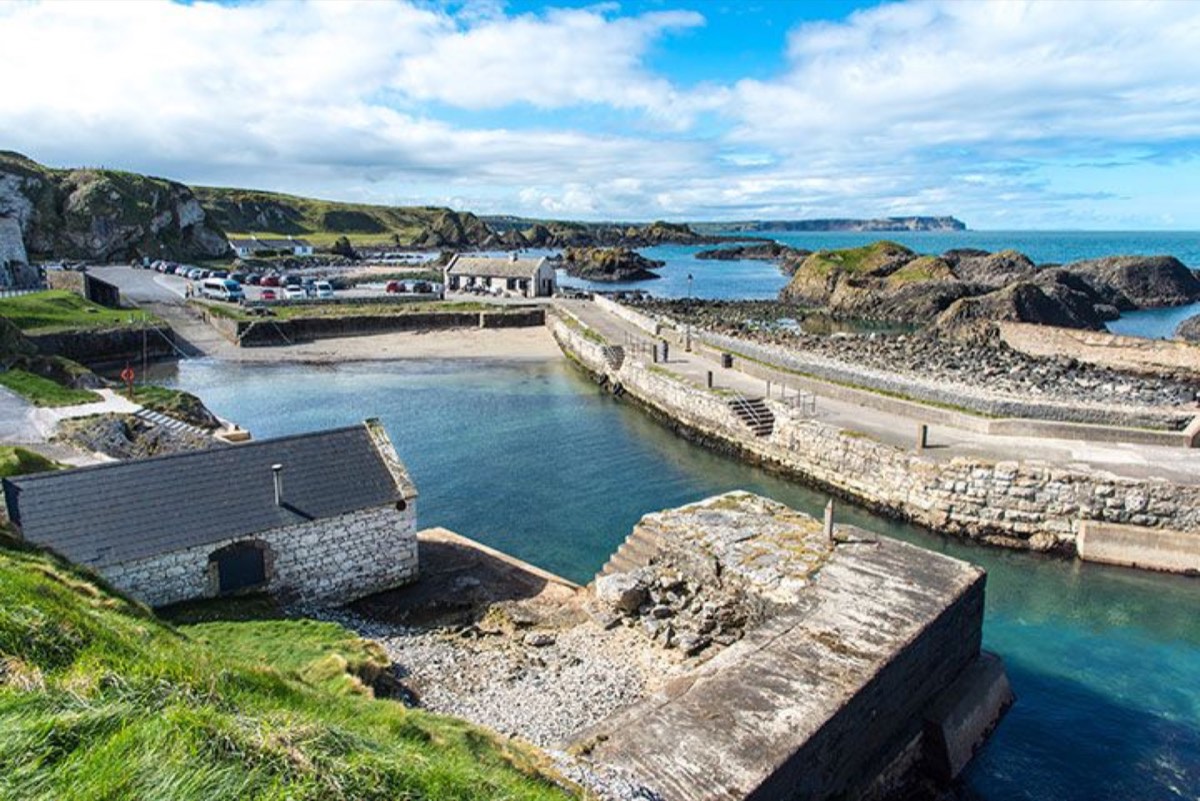
The promontory that is Portrush has several small inlets and bays that are ideal for landing boats, such as Portandhu, the salmon Fisheries and the ladies bathing place near the Arcadia. However, none offer the natural harbour as the where today’s Old Dock is.
Indeed, Portrush is derived from the old Irish Port Rois, meaning ‘port on the promontory’ making reference to the harbour and the impressive promontory headland. As far back as 1468, there is a reference to “Porto Rosso” in Venitian maps.
Maps from the 19th Century show Portrush with the dock at the heart of the fishing village; today the Old Dock is a unique surviving element of the earlier harbour and is protected as a scheduled area.
With the increase in shipping during the 1700s and early 1800s, the town council decided to invest in a new harbour to accommodate the rise in maritime merchant traffic, along with the size of ships.
At this time Windjammers were the largest merchant ships afloat, and with the harbours improvements, these ships could now dock at Portrush. The quayside developed to adapt to the needs of a busy port, and the Portrush Steam Navigation Company was established in 1845 to provide regular passenger and freight crossings to Liverpool.
Sadly, the harbours business did not fare well during the upheaval of world wars and the great depression. With the trend for maritime freight and passenger vessels shifting to larger ports, the decline continued.
Today, commercial fishing boats are rarely seen; however, modern marina facilities have been provided for day fishing craft, yachts and pleasure boating. However, there is an increasing number of thriving charter businesses now operate from the Portrush harbour mainly for tourists.
Ramore Head
Covering the northern end of the Pormonotary, Ramore head, along with Lansdowne and the Skerries, has long been seen as of historical importance.
The ‘Portrush Rocks were first “discovered” in 1799 by Reverend William Richardson and written about by the Royal Society. This started a scientific debate between the Neptunits and the Plutonists that lasted for several decades. The Plutonists believed that all rocks came from volcanic magma, where the Neptunists thought the stones were formed from seawater.
In 1996, the area around Ramore Head, Lansdowne and the Skerries were named as an Area of Special Scientific Interest (or A.S.S.I.). This highlighted the importance of the environment of Portrush and the surrounding area.
Ramore head is one of the best places in Portrush for a walk, with the cliff path skirting the edge and the recreation ground in the valley. You can find an excellent map here. There are spectacular views of Donegal, Rathlin Island, Portrush and on bright days all the way to Islay. On clear days, visitors can see the Donegal hills and even as far as Scotland across the Atlantic Ocean.
There are also sites as the Devils Washtub and the Old Wireless Listening station, used in World War 2 as one of the Top Secret Y stations for intercepting enemy transmission and forwarding them to Bletchly park for decoding.
The Skerries
The Skerries are the chain of tiny islands that lie east of Ramore Head just offshore. These bleak, rocky islands are uninhabited and ideal for supporting a diverse ecological habitat.
The islands are a haven for rare seabirds such as Kittiwake, Black Guillemot and Eider Duck.
As with many parts of this island, there are plenty of myths and legends surrounding them, including one that pirate Tavish Dhu is said to have buried his treasure on one of the islands.
The stretch of water between the islands and the coast is known as the Skerries Roadstead. The Roadstead has provided a refuge for vessels escaping bad weather or needing an anchorage to take on cargo, crew or passengers and its proximity to the shore, and the depth of the channel, make it a safe haven for ships, large and small.
Archaeology of Portrush and the North Coast
Documents from the early 1300s list a church at “Portrossce”, possibly the first time Portrush name appears. Before this, it was called Cuan-ard-Corran (Point of the High Corner. The remains of this Church is suspected to have been on Bath Street, under the Portrush Atlantic Hotel.
Antrim Gardens
Antrim Gardens Portrush
During recent excavations in The Antrim Gardens, intriguing discoveries have been made by Archaeologists. These include a series of possible stone ovens. These discoveries suggest that this is evidence of a large kitchen which may have served the Community associated with the Church.
Thousands of sherds of pottery were also collected, helping to date the busiest period of habitation on the site to between the thirteenth and fifteenth centuries. Other finds at the Antrim Gardens site include flint implements dating to the Mesolithic Period of 8000BC to 4000BC.
Corrstown
Antrim Gardens is not the only archaeological dig to have taken place in Portrush, In 2002 an excavation of The Corrstown area of the town, now the Hopefield Housing estate.
You can see from the Aerial photographs some circular features in the fields, that gave an indication that something lay underneath. Initially, these were thought to be small prehistoric buildings. However, as the top few inches of soil were pulled back, the extent of the archaeology became clear.
The discovery at Corrstown discovered would change our understanding of life in the Bronze Age on the island of Ireland. Seventy-four buildings were found, these ranged from large circular buildings to small oval buildings.
Radiocarbon dating by Queens University placed the settlement in the Middle Bronze Age (c.1700-1200 B.C.). What was uncovered provided extensive evidence for a settled and organised Middle Bronze Age village that thrived at Corrstown for over 200 years?
A number of the houses linked through sunken cobbled pathways and a roughly cobbled road, as would be found in Roman times a through the eastern side of the site.
Beaches
With nearly 4 miles (6km) of sandy beaches that stretches along the town’s coastline, Portrush boasts the spectacular Portrush beaches, including three of Northern Ireland’s most celebrated Blue Flag beaches. The beaches are a mecca for holidaymakers and surfers. Convenient car parking and a large car park are available near the main beaches, enhancing accessibility for all visitors. These beaches are especially popular during the summer months, attracting visitors from across Northern Ireland and beyond. You can find tide times here.
West Strand Beach
WEst Strand Beach Sometimes Called MIll Strand
West Strand, also known as Mill Strand forms part of West Bay stretching half a mile (1 km) from The Harbour at the northern end to the Black Rocks on its southern end. Along the beach is along a pedestrian/cycle promenade that is popular with runners, walkers and cyclists. The cycle route forms part of way 92 and extends to Portstewart.
Convenient car parking is available for visitors near West Strand Beach, making access to the promenade and beach facilities easy.
West Strand Beach regularly achieves the internationally recognised Blue Flag Award, most recently in 2019.
Keep an eye out for the resident pod of harbour porpoises just off the shore, as they pop up.
East Strand
East Strand Beach, at the heart of the coastal resort of Portrush, forms a continuum of sand, approx. 2.5 km / 1.6 miles long, Starting at the Arcadia Ballroom and running past massive dunes that hide Royal Portrush Golf Club and merges with Curran Strand and Whiterocks.
There is a Promenade for the first mile then it’s onto the sandy beach. The Beach is famous all year round with family activities, including walking, and horse riding, if you are up early, you’ll catch horses galloping along the Beach. East Strand Beach is especially lively during the summer months, with increased numbers of visitors and family activities.
From the East Strand, there are fantastic views of The Skerries and the Causeway headlands.
Just next to the East strand Car Park, which is a large car park providing ample parking for beachgoers, stands a Bronze Statue created by German artist, Holgar Lonze. It was unveiled in 2011 and stands 4.2m tall. The inspiration for the statue was Portrush”s rich maritime history, and the sculpture is influenced by a Dronthiems Passage sail.
Curran Strand – Whiterocks
The Curran Strand, more commonly known as White Rocks, stretches along the coast and gets its name from the stunning white chalk cliffs that date to the Cretaceous Period. A thick layer of black basalt caps this white chalk, evidence that lava flowed over this area during the Palaeogene Period.
Famous Buildings
The White House
The Whitehouse Superstore Portrush
The White House was established in 1890 by Henry Hamilton, who came to Portrush as an apprentice grocer but left for America, where he became a wealthy man. On his return established the business selling fashionable ladies and menswear. The Whitehouse was one of the first mail-order publishers in 1899. The store became famous and was soon supplying the British Royal Family and even the Indian Raj.
Portrush Post Office
Built-in 1908, The Portrush Post Office building was built to cope with the huge demand created by the mail-order business by the White House department store. When it was built, it was the most modern and largest local Post Office in Ireland.
The Whitehouse publishing over 20,000 copies of a colourful catalogue called the “White House Budget” each Christmas. From the Christmas of 1906, the catalogue was dispatched, for free, to thousands of eager customers.
The building is now the town public library, with the upper three floors having been converted into apartments in the early 2000s
The Playhouse Cinema
The Playhouse Cinema, called The Majestic Cinema initially, opened its doors on 10 April 1939 showing Goerge Bernhard Shaws film ‘Pygmalion’ starring Leslie Howard. The Playhouse had 400 seats in the main stalls and a further 380 in the balconies.
It was furnished to an exemplary high standard for the day and still stands as an example of classic “The Art Deco” style. Sad;y due to the advent of television and the Troubles in the 1970s it was forced to close. Fortunately, it has now been brought back into life as a thriving community venue with a bar, theatre and occasionally cinema once more.
The Belfast Bank Building
This stunning building, on The corner of Mark Street and Church Pass, was completed in February 1898 by architect Vincent Craig, of Belfast. At the time it was highly praised for “the artistic beauty of its design…singularly pleasing by the tasteful intermingling of Dungiven stone dressings with red brickwork.”
The Bank Building was in use for over a Century, bought over by Northern Bank in 1970 and later in 2005 by Danske Bank, before closing its doors as a bank in 2012. In 1977 it became a protected heritage building. It was recently bought over by and is due to become a boutique hotel.
The Londonderry Hotel
The Londonderry Hotel was opened in 1870 by William and Isabelle Osbourne, sadly William passed away within a year of opening, leaving Isabella as the proprietor of the hotel. There were only four hotels in Portrush at the time, all of which were highly profitable. In 1876, Isabella had used her shrewd business acumen sold her share of the Londonderry Hotel and bought the neighbouring premises, in which she opened the Osborne Temperance Hotel.
The Trocadero
The Trocadero was originally the Osbourne Temperance Hotel. The hotel was bought in 1919 by Hugh Black who transformed it into “the finest restaurant in the kingdom” where travellers could “find everything they desired”.
Unfortunately, tragedy struck when the restaurant burnt down in 1921, reportedly causing a complete blackout of Portrush due to the fire damaging the electricity network.
The legacy of the Londonderry Hotel and Trocadero Restaurant is preserved in a tiled pavement mosaic in Main Street.
The Arcadia Ballroom
What we now know as The Arcadia Ballroom was redeveloped in 1911 by local grocers John Campbell and Robert A. Chalmers. The building had previously been called the Rock Cafe being described as a “garden roof café…overlooking the ladies’ bathing place” The rooftop and cafe could accommodate over 200 people.
In later years, another storey was added, and further expansion included a ballroom in 1953 where concerts and dances were held (now demolished).
In addition to a café, the Arcadia now also includes an upstairs function room which was the original ballroom used for tea dances, concerts and community events.
The Palladium Ballroom
Showing the popularity of Portrush, the seaside town had two Ballrooms. Opening in 1939, the possibly less well known of ballrooms, the Palladium Ballroom offered young people a balcony milk bar and café.
The maple sprung wooden floor a large bandstand and space for 150 people made for an excellent dancing experience.
It is now the parish hall for the nearby St. Patrick’s Roman Catholic Church.
Outdoor Activities
Portrush is a paradise for lovers of the outdoors, offering a wealth of activities set against the breathtaking backdrop of the Causeway Coast in County Antrim, Northern Ireland. The town’s three sandy beaches—West Strand, East Strand, and White Rocks—are perfect for everything from a relaxing stroll to an invigorating swim in the Atlantic Ocean. Water sports enthusiasts will find plenty to keep them busy, with surfing, paddleboarding, and kayaking all popular along the coast. Several local surf schools and rental shops make it easy for beginners and seasoned surfers alike to catch a wave.
Golfers from around the world are drawn to the legendary Royal Portrush Golf Club, the only golf club outside of Britain to have hosted The Open Championship. With its challenging links and magnificent views over the ocean and giant sandhills, it’s a must-visit for any golf fan. For those who prefer to explore on foot or by bike, the coastal paths around Portrush offer scenic routes with panoramic vistas of the Atlantic and the rugged limestone cliffs that define this stretch of the north coast.
Portrush Harbour is a hub for fishing and boating, with charter trips available for those keen to try their luck at sea or simply enjoy the coastline from a different perspective. Whether you’re looking to relax on golden sands, tee off at a world-class golf club, or set out on a coastal adventure, Portrush is the perfect base to explore the very best of Northern Ireland’s outdoor activities.
Family-Friendly Activities
Portrush is a fantastic destination for families, offering a wide array of attractions and activities to keep everyone entertained. The town’s beaches, especially Portrush East Strand Beach, are ideal for family fun—think sandcastle building, paddling in the shallows, or simply enjoying the golden sands together. The East Strand Beach is renowned for its clean, safe environment and is a favourite spot for both locals and visitors.
No family trip to Portrush is complete without a visit to Barry’s Amusements, the largest amusement park in Northern Ireland. With its exciting rides, games, and classic attractions, it’s a place where children and adults alike can make lasting memories. For water lovers, the Waterworld swimming complex offers hours of fun with its pirate-themed pool, water slides, and splash zones.
Beyond the beach, families can explore the dramatic ruins of Dunluce Castle perched on a cliff edge, or take a short drive to the world-famous Giant’s Causeway for a day of adventure and discovery. Ramore Head, with its sweeping views of the coastline, is perfect for a family picnic or a gentle walk, offering plenty of space for children to run and play while adults soak in the magnificent views. With so much to see and do, Portrush is a true family-friendly gem on Ireland’s north coast.
Shopping and Dining
Portrush boasts a lively shopping and dining scene that reflects the town’s vibrant seaside character. Stroll along Main Street and you’ll discover a variety of unique shops, from surfwear boutiques and gift stores to charming souvenir shops where you can pick up a memento of your visit. Whether you’re searching for handmade jewellery, local crafts, or traditional Irish clothing, there’s something for every taste.
When it comes to dining, Portrush offers an impressive selection of restaurants, cafes, and bakeries. Fresh seafood is a highlight, with many establishments serving up the catch of the day alongside classic Irish dishes and international cuisine. The Harbour Bar and the Atlantic Hotel are popular choices, offering delicious meals with stunning views over Portrush Harbour and the sweeping coastline. For a more casual bite, the town’s cafes and bakeries tempt visitors with homemade pastries, cakes, and other sweet treats—perfect for a relaxing break after a day exploring the beaches and shops. Whether you’re after a hearty meal, a quick snack, or a leisurely coffee, Portrush’s dining scene has you covered.
Events and Festivals
Portrush is a town that loves to celebrate, with a packed calendar of events and festivals that bring the community and visitors together throughout the year. One of the highlights is the annual air show each September, when the skies above the town come alive with thrilling aerial displays and performances that draw crowds from across Northern Ireland and beyond. Music lovers can enjoy the Portrush Music Festival, which showcases a diverse line-up of local and international acts in venues around the town.
Golf fans won’t want to miss the tournaments hosted by the Royal Portrush Golf Club, including the world-renowned Open Championship, which puts Portrush firmly on the global sporting map. The harbour area is also a focal point for events, with fishing competitions and the ever-popular RNLI raft race providing fun and excitement for all ages. For those interested in local culture and history, the Portrush Heritage Centre offers exhibitions and activities that celebrate the town’s rich heritage. No matter when you visit, there’s always something happening in Portrush to make your stay memorable.
Visitor Information
Planning your visit to Portrush is easy, thanks to the wealth of information and resources available to help you make the most of your time on the Causeway Coast. The town’s visitor information centre, conveniently located on Main Street, is your go-to spot for brochures, maps, and expert advice from friendly staff. Whether you need help finding the perfect hotel, booking a local tour, or discovering hidden gems along the coast, the centre is there to assist.
Portrush offers a wide range of accommodation options, from stylish hotels and cosy guesthouses to self-catering apartments, ensuring there’s something to suit every budget and preference. The town’s official website and social media channels are also excellent sources for up-to-date information on events, attractions, and local heritage. With its stunning coastal location, welcoming community, and endless opportunities for adventure and relaxation, Portrush is the perfect gateway to exploring Northern Ireland’s spectacular Causeway Coast.
Population of Portrush
Portrush has a population of 6454 (2011 census), up from 6372 in 2001. This was broken down as
– 18.89% aged under 16 years and 19.09% aged 65 and over;
– 48.22% of the usually resident population were male, and 51.78% were female, and 42 years was the average (median) age of the people.
Ethnicity, Identity, Language and Religion
– 98.62% were from the white (including Irish Traveller) ethnic group;
– 24.84% belong to or were brought up in the Catholic religion and
– 66.90% belong to or were brought up in a ‘Protestant and Other Christian (including Christian related)’ religion
– 63.43% indicated that they had a British national identity,
– 11.93% had an Irish national identity and
– 32.89% had a Northern Irish national identity*
– 4.83% had some knowledge of Irish;
– 15.75% had some knowledge of Ulster-Scots; and
– 3.18% did not have English as their first language.
Health
– 21.07% of people had a long-term health problem or disability that limited their day-to-day activities;
– 79.80% of people stated their general health was either good or very good;
– 11.92% of people indicated that they provided unpaid care to family, friends, neighbours or others.
Housing and Accommodation
– 63.42% of households were, and 33.14% were rented;
– 35.84% of households were owned outright;
– 13.60% of households were comprised of a single person aged 65+ years;
– 7.72% were lone parent households with dependent children; and
– 25.85% of households did not have access to a car or van.
Qualifications
28.71% had a degree or higher qualification; while
37.61% had no or low (Level 1*) qualifications.
Labour Market
61.94% were economically active, 38.06% were economically inactive;
54.28% were in paid employment; and
4.97% were unemployed.